Tampilkan postingan dengan label Crime. Tampilkan semua postingan

Jumat, 09 September 2011

Central America Violence

According to InSight Crime, 2011 is lining up to be a terrible year for Honduras and El Salvador. 
Honduras is on track to reach a murder rate of 86 per 100,000 inhabitants in 2011, while El Salvador could see a rate of 72 per 100,000, according to new reports.
On the other hand, August was another relatively nonlethal month for Guatemala and the country is on track to have somewhere between 39 and 40 murders per 100,000. 
Granted these estimates assume that murders occur at roughly the same rate for the remaining months as they occurred during the first eight months of the year. That's a big if especially considering that the last few months tend to be more violent, at least in Guatemala. 
However, at what point do reporters and analysts stop lumping Guatemala, El Salvador and Honduras together as the murderous northern triangle? 
At a minimum, it looks like El Salvador and Honduras should be discussed in one extreme category with rate over 70 per 100,000. 
Guatemala and Belize should follow in a second, still dangerous, but less severe category with 40 per 100,000.
Finally, Nicaragua and Costa Rica comprise the third and final category with a rate just over 10.

Kamis, 01 September 2011

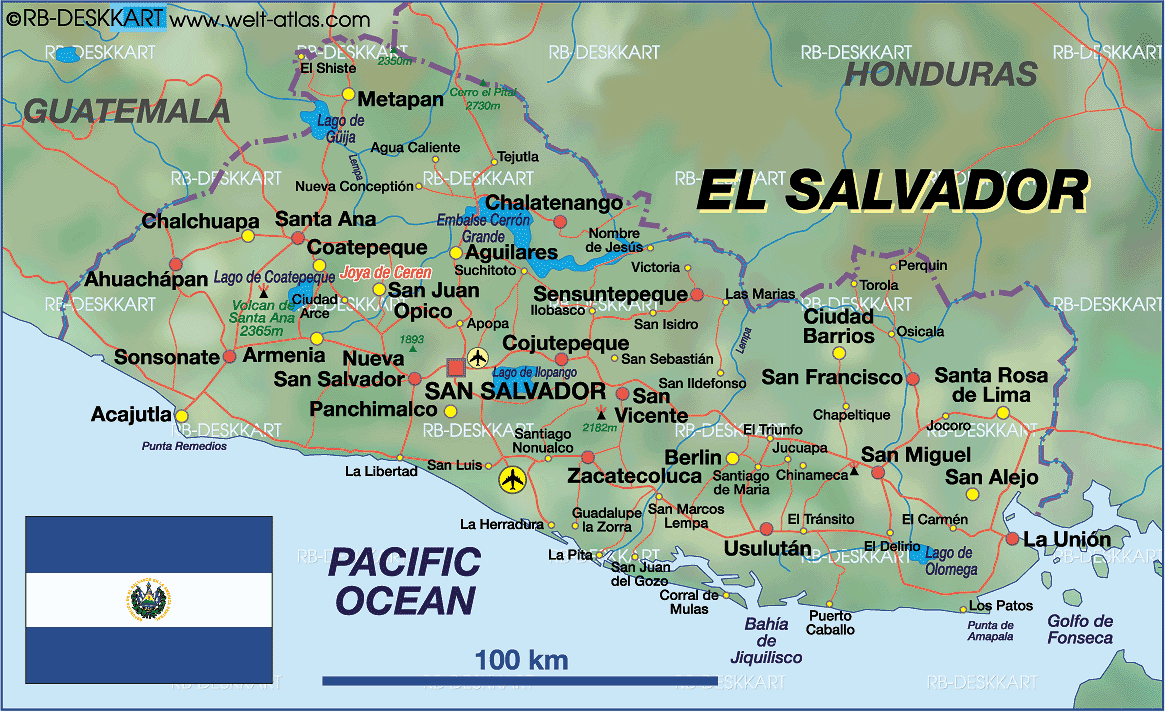
Murders increase in El Salvador


According to an article in Inside Costa Rica, 40 people were killed over the weekend in crime-related activities. Unfortunately, the Civilian National Police report that the number of people murdered between January and August 2011 exceeded the same periods in 2009 and 2010. 

During roughly the first nine months of this year, 2,755 people were murdered. That number exceeds the 2,731 murders that occurred during the same period in 2009, "the most violent year of the previous decade, with a total of 4,296 people killed."

Obviously, that's not a good sign. However, it's not necessarily the case that 2011 will be more violent than 2009. It depends on how the last four months play out compared to the last four months of 2009. And even though 24 more people were killed during the first eight months of 2011 compared to the first eight of 2009, the rate per 100,000 is roughly the same once you compensate for population growth. That's not good enough, but it's a little food for thought.

Selasa, 15 Maret 2011

Youth Victims in Guatemala

In recent years (2005-2010), 400 youth have been killed each year in Guatemala. According to NANA, a nongovernmental organization, during the first two-plus months of 2011, 106 minors have been killed. Twenty nine girls between the ages of 12 and 15 are included in those numbers. As of last week, 127 women had been murdered so far this year.

Many of the young victims previously had been victims of sexual assault, torture, and child labor. Meanwhile Interior Minister Carlos Menocal does not deny that death squads engaged in social cleansing exist today.

According to the Interpeace Regional Youth and Gang Violence Prevention Programme,
over an 11 month period last year, 433 children under the age of 17 suffered violent deaths. 3,337 young people between the ages of 28-35 also died due to violence.

INTERPEACE is a Geneva-based international peacebuilding organization founded in 1994 "that plays a discrete role in helping societies war-afflicted societies to build lasting peace." It has just published a report that outlines "12 clear strategies and associated objectives and actions to combat youth related violence" in Guatemala.

The violence against children continued this weekend with Six dead in latest Guatemala crime wave. The bodies of six youth, including three brothers ranging in age from 9 to 18, were found in a community 30 kilometers northeast of Guatemala City.

Meanwhile, Carlos Mendoza has posted murder statistics broken down by municipality, department, sex, and weapon between 2000 and 2010 at The Black Box. Hopefully the availability of this data will be used to better understand the complex nature of violence in Guatemala today.

Finally, as if murder was not all Guatemalans had to fear, 56 kidnappings have been reported so far this year, double last years total. Ten of the 56 involve minors as the victims.
Una Centroamérica violenta, infestada por el narcotráfico y el crimen organizado, con estados débiles y dominados por la impunidad recibirá a partir de mañana al secretario general de las Naciones Unidas, Ban Ki-moon.
This is the situation that Ban Ki-Moon will hear and see when he arrives in Guatemala on Tuesday.

Kamis, 10 Maret 2011

Verdict and Sentencing in Poveda Trial

Franco-Spanish filmmaker Christian Poveda was murdered in September 2009 while making "La Vida Loca" ("The Crazy Life"), a documentary about gangs in El Salvador. On Tuesday, a brief two-day trial brought back a guilty verdict for 11 gang members and one police officer. The convicted each received prison terms ranging from 4 to 30 years.

The court convicted Jose Melara of the Mara 18 for ordering the killing. However, the exact motive for the killing isn't exactly clear. The Miami Herald article mentions three possible motives. According to the attorney general, a former policeman who was convicted as an accessory to the crime, said that Poveda was killed because he had been acting as an informant. However, other police officials deny that Poveda ever worked as an informant.

A second scenario is based upon other suspect testimony that Poveda was killed because his documentary showed gang members breaking the law. Poveda broke his promise with the gang wherein he had promised not to show the film in El Salvador. This scenario appears to be gaining traction.

Finally, Police Assistant Investigations Director Howard Cotto provides a third scenario where the gang's leadership disagreed about how much Poveda should be allowed to film.

In the end 11 people were convicted - 3 for participating in his murder and 8 for unlawful association. Another 20 were found not guilty. Seventeen of those 20 are still in jail, however, serving time for other offenses.

Reporters Without Borders released a statement shortly afterwards saying that the two-day trial and subsequent verdict left the staff and organization with "mixed feelings" and unanswered questions, a "mixture of relief and frustration."

It's nice to see a conviction in this high-profile case. Murder convictions in El Salvador are few and far between. However, it's also an example of the weakness of the justice system where a case involving 31 suspects was concluded in two days and there still seems so much uncertainty surrounding the exact motive for the crime.

Senin, 24 Januari 2011

Bloody weekend, better month in El Salvador

El Salvador also suffered though its most violent day of the year this weekend. The PNC reports that there were twenty-one murders on Sunday. Sunday surpasses back-to-back violence of January 7 and 8 when seventeen people were killed each day (Contra Punto).

Seven murders occurred in San Salvador, four in Santa Ana, three in both Usulután y La Libertad, two in Sonsonate and one in La Unión.

However, murders are down compared to last year. During the first twenty-three days of 2010, three hundred and two people were murdered whereas "only" two hundred and sixty-seven have been murdered so far this year.

Minggu, 23 Januari 2011

Violent Start to Year in Guatemala

La Hora
While January is not yet complete, it is shaping up to be a pretty violent one in Guatemala. On Sunday, three young men were shot and killed and five others were seriously injured during a funeral service in a Protestant Church on the outskirts of Guatemala City. The funeral service was for a young man who had been murdered on Friday. Police are blaming the killings on youth gangs.

On Saturday night, one person was killed and another four injured during a shootout at a disco in Zona 1 of the capital. And in a particularly bloody day, twenty-three people were murdered on Friday. Six of the victims were women and one was five months pregnant.

On Thursday night, four people were killed (including a ten-year old boy) and another fourteen wounded during an attack targeting youths playing basketball or soccer in the Guatemalan capital. Like the Sunday killings, police are speculating that the motive for the shooting may have been score-settling between gangs.

In a survey earlier this month, seventy-eight percent of the respondents reported that violence and insecurity were the main problems facing the country. Last week's events are not going to change that.

Rabu, 19 Januari 2011

Former Congressman Assassinated in Guatemala

A former member of Congress from the Patriotic Party was murdered on Wednesday inside a shopping mall in the western part of Guatemala City (Prensa Libre, El Periodico, Siglo XXI). Edgar Antonio Almengor Pérez was a deputy from the Suchitepéquez Department for the Patriotic Party. He served during the 2004-2008 term.

While police do not as of yet have a motive for the crime, they do not think that it was random.  The shots were accurate and the suspect fled in a waiting car. Almengor died at the scene.

Kamis, 13 Januari 2011

$150 to Murder a Woman

While homicides were down last year, 2011 is not starting off so well. The bodies of three women were discovered in a ditch in Zone 8 of Mixco, outside Guatemala City on Wednesday. Authorities had found another woman's body in the same area the day before.  The bodies were in such bad condition that authorities could not establish the physical characteristics of the women.

Last year, an average of two women were killed each day in Guatemala.  The 838 women killed in 2010 is double the total from 2003 (416).  

While we don't know who killed these women, the public prosecutor's office has determined that that former husbands, former colleagues and even boyfriends need only pay a sum of $150 for having a woman murdered.

It should come as no surprise that violence and insecurity are at the top of Guatemalan concerns.

Rabu, 12 Januari 2011

Death Toll up to 9 in Guatemala

The death toll from last week's bus bombing in Guatemala rose to nine after Berania Lopez died of his wounds at Roosevelt Hospital. 

The eighth victim had been buried on Tuesday when Jorge Efraín Cac Gutiérrez said good-bye to the last of his three sons that died in the bombing.  Following the death of his sons and wife, as well as attempted extortion following their deaths, Cac tried to commit suicide on Monday.  US Ambassador McFarland attended the funeral and reported that the US would provide FBI assistance should the Guatemalan government request it.

Eswin Carol Gálvez, a surgeon at the Retalhuleu hospital, was recently murdered in front of his home.  The suspects fled after shooting Dr. Gálvez in the back of the head and made no attempt at stealing anything.

 
Finally, in other news, former Interior Minister Raul Velasquez surrendered to authorities on Tuesday. Velasquez has been wanted since March on corruption charges.
Fired March 1 by President Alvaro Colom, Velasquez is accused of collecting a 50-percent kickback on a 40 million quetzal ($4.9 million) contract to supply fuel to the national police.
The then-minister stashed the money at banks in Panama, Brazil and the United States, prosecutors say.
Velasquez also faces a separate indictment in connection with a contract for renovations at a maximum-security prison.
Here's the cartoon from Prensa Libre wondering why it took him so long to turn himself in.  Apparently, he wanted to spend the holidays with his family.

Selasa, 04 Januari 2011

Arrest in Bus Attack

Guatemalan authorities have arrested a suspect in Monday's bombing of a bus on the Guatemala City - San Juan Sacatepéquez route.  The attack left seven dead and fifteen injured.  Police believe that a woman left the bomb on the bus and detonated it by cell phone. However, it doesn't appear certain that they know how the bomb was detonated (or at least they are not sharing the information).

Authorities arrested twenty year old Sonia Elizabeth Véliz Hernández or Dominica Isabel Carrera Hernández (not sure which is the real name) on Tuesday.  She is alleged to be a member of MS-13 complete with tattoo markings on her chest and two tears under her left eye.

It still appears that the attack was tied to an extortion racket in which transport companies on that route had been targeted for the last several years and follows a recent year end report on the dangers of working in the Guatemalan transport sector.
Guatemalan bus drivers paid US$1.5 million (S$1.92 million) in extortion money to organised crime rings in 2010, according to a police report out on Monday.
Over the course of 2010 police arrested more than 500 criminals and charged them with trying to extort money from business owners and workers.
Some of those charged were members of the notorious Mara 18 street gang, according to Donald Gonzalez, a spokesman with the national civil police.
Public transport workers appear to be at particular risk. Human rights groups said that between January and November, 119 drivers and 51 transport aides were shot dead.
While gangs have killed drivers, assistants, and passengers in the past, this does appear to be a major escalation.  It's also reminiscent of last years attack on a bus in Mejicanos, El Salvador.

Minggu, 02 Januari 2011

Guatemala - Not So Violent Year?

The AP has a story floating around documenting the toll that gunshot victims have on Guatemalan emergency rooms.
Massive numbers of cases have stretched the San Juan de Dios Hospital, Guatemala City's largest, to the breaking point. The medical facility, along with the city's Roosevelt Hospital, treated 1,224 gunshot and knife-wound patients from January to November this year...

Health Minister Ludwig Ovalle says treating victims of violence costs about $44 million, or about 10 percent of the department's total annual budget.
You can check out photos from Guatemala's emergency rooms here.

While you wouldn't know it, the total number of murders committed in 2010 declined relative to 2009 (Inside Costa Rica).  As of Christmas, 6,502 murders had been reported, down 6% from the 6,948 murders reported last year. 

In terms of where the murders occurred, approximately 58% occurred in the department of Guatemala (a department with 21% of the country's population).  Escuintla finished second with about 12% of the murders (and 4% of the population).  While the total number of murders were down, authorities said that there had been a greater cruelty in perpetrating such crimes (beheadings and signs of torture).

In terms of the victims, 178 urban or suburban bus drivers were killed.  According to the Mutual Support Group (GAM), store owners and employees were also targets of crime with 101 killed, often the result of extortion gone bad.  Forty-eight police officers were also killed. 

In terms of the perpetrators, most of the killings were linked to organized crime and gang-on-gang conflict (Xinhua). 
The Guatemalan Interior Ministry estimated 60 percent of the country's murders were committed by gangsters against ordinary citizens. Another 25 percent were caused by turf wars between the gangs, and the remaining 15 percent were due to crimes of passion or robberies.
While I don't think that anyone should be out celebrating the 6% drop in murders, sorry to say, but it's better than a 6% increase.  I'm hoping for a safe and happy new year, but I am worried.